Diabetic Retinopathy in Malleshwaram: Understanding Diabetes-Related Vision Loss and How to Prevent It
If you live with diabetes, your eyes are working under quiet pressure every single day. India is now home to one of the largest diabetic populations in the world, and studies estimate that roughly 12 to 18 percent of Indians with diabetes already show signs of diabetic retinopathy — often without realising it. The most worrying part? Most patients only discover the problem when their vision has already started slipping. Diabetic retinopathy is the leading cause of preventable blindness among working-age adults globally, and Bangalore is seeing rising case numbers as urban lifestyles drive up diabetes rates. The encouraging news is this: with early screening, lifestyle discipline, and the right specialist support, vision loss from diabetes is almost entirely preventable. This guide walks you through what diabetic retinopathy actually is, the warning signs you cannot afford to ignore, and how the team at Dr Solanki Eye Hospital helps patients in Malleshwaram protect their sight for the long term.
Quick Navigation
What Exactly Is Diabetic Retinopathy?
Diabetic retinopathy is damage to the delicate blood vessels at the back of your eye, caused by prolonged exposure to elevated blood sugar. Your retina is the thin layer of tissue lining the inside of your eyeball — it captures light and sends visual signals to your brain. When sugar levels stay high for years, the tiny vessels feeding this tissue begin to weaken, leak, and sometimes close off completely. What makes the condition so deceptive is that early damage produces no pain and almost no visible symptoms. By the time blurriness or floaters appear, real harm has usually already occurred. Both Type 1 and Type 2 diabetics are vulnerable, and even people with prediabetes can begin to develop changes in the retina over time. This is why ophthalmologists treat diabetes as an eye disease as much as a metabolic one.
The Four Stages You Should Know
Diabetic retinopathy does not arrive all at once. It progresses through identifiable stages, and catching it in the earlier ones makes treatment far more effective.
- Stage 1 — Mild Non-Proliferative Retinopathy: Tiny bulges called microaneurysms form on retinal blood vessels. Vision usually remains normal, but the damage has started.
- Stage 2 — Moderate Non-Proliferative Retinopathy: Some of these vessels begin to swell and distort, reducing their ability to transport blood. Patients may still feel fine, but a dilated exam will reveal clear changes.
- Stage 3 — Severe Non-Proliferative Retinopathy: A larger number of vessels become blocked, starving sections of the retina of oxygen. This triggers the retina to send chemical signals demanding new blood supply — setting the stage for the most dangerous phase.
- Stage 4 — Proliferative Diabetic Retinopathy: New, fragile blood vessels grow on the retinal surface in response to oxygen starvation. These vessels bleed easily, leading to floaters, sudden vision loss, retinal detachment, and ultimately blindness if untreated. A separate but related condition, diabetic macular oedema (DME), can develop at any stage. It happens when fluid leaks into the macula — the part of the retina responsible for sharp, central vision — causing rapid blurring even when the rest of the retina looks relatively healthy.
Six Warning Signs You Must Not Ignore
Most patients miss the early warning signs because they appear gradually or disappear briefly before returning. If you have diabetes and notice any of the following, book a retinal evaluation without delay.
- Vision that fluctuates throughout the day — clearer some hours, hazier others
- Spots, threads, or “cobwebs” drifting across your sight (floaters)
- Difficulty distinguishing colours, especially blues and reds
- Patches of blurred or missing vision in the central or peripheral field
- Reduced night vision or longer recovery time when moving from bright to dim light
- Sudden flashes of light that come and go without warning
A single mild symptom is enough reason to schedule a check-up. Waiting for “real problems” to appear is the most common reason patients lose vision they could have kept.
Who Is Most at Risk?
Anyone with diabetes can develop retinopathy, but certain factors significantly raise your odds. Understanding why each factor matters helps you take meaningful action rather than treating the list as a generic warning.
- Long-standing diabetes — risk climbs steadily after 5 years of diabetes; after 20 years, most Type 1 diabetics and the majority of Type 2 diabetics show some retinal change.
- Poorly controlled blood sugar — HbA1c levels consistently above 7 percent accelerate vessel damage dramatically.
- High blood pressure — adds mechanical stress to already fragile retinal vessels and worsens leakage.
- High cholesterol — increases lipid deposits in the retina, contributing to macular oedema.
- Pregnancy — hormonal changes can rapidly worsen existing retinopathy in diabetic women; close monitoring is essential.
- Smoking — narrows blood vessels throughout the body, including the eye, and reduces oxygen delivery to the retina.
- Kidney disease — diabetic kidney damage and retinopathy often progress in parallel.
- Ethnicity and family history — South Asians, including the Indian population, show higher rates of diabetes-related complications than many other groups.
When to Seek Emergency Eye Care
Some symptoms are not “wait and watch” situations. If you experience any of these, contact an ophthalmologist immediately or visit an eye emergency service the same day:
- A sudden shower of floaters or a dark “curtain” descending across your vision
- Abrupt, severe loss of vision in one or both eyes
- Flashes of light combined with vision changes
- Sharp eye pain along with redness and visual blurring
These can indicate vitreous haemorrhage or retinal detachment — both of which need rapid intervention to preserve sight. To understand the full range of urgent care available, you can
Visit Dr Solanki Eye Hospital for more on emergency services and specialist consultations.
How Diabetic Retinopathy Is Diagnosed
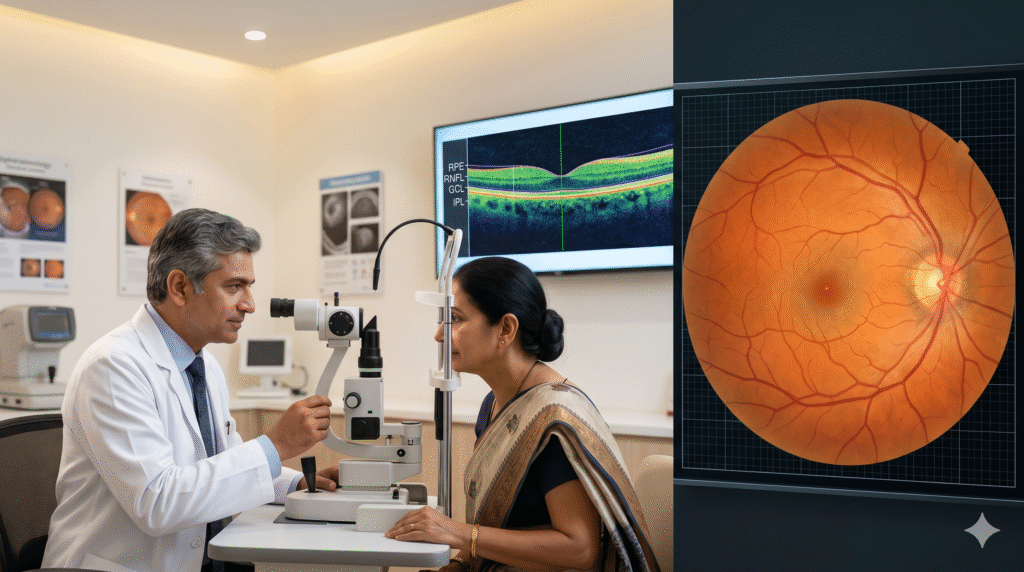
A standard vision test will not catch diabetic retinopathy. Diagnosis requires specialised retinal imaging performed by an ophthalmologist trained in diabetic eye disease. At Dr Solanki Eye Hospital, our diagnostic workflow typically includes:
- Dilated Eye Exam — Eye drops are used to widen the pupil, allowing the ophthalmologist to examine the retina and optic nerve in detail for signs of damage.
- Optical Coherence Tomography (OCT) — A non-invasive scan that produces high-resolution cross-sectional images of the retina, helping detect fluid, swelling, and structural changes layer by layer.
- Fundus Photography — Detailed photographs of the retina are taken to document the current state of blood vessels and monitor changes over time.
- Fluorescein Angiography — A dye is injected into a vein in your arm and photographs are taken as it travels through retinal blood vessels, revealing leaks, blockages, and abnormal vessel growth.
- Intraocular Pressure Measurement — Checks for raised eye pressure, which can compound retinal damage when combined with diabetic changes.
Treatment Options That Save Sight
Treatment depends on the stage of retinopathy and how quickly it is progressing. Options available at Dr Solanki Eye Hospital include:
- Tight Metabolic Control — In the earliest stages, aggressive control of blood sugar, blood pressure, and cholesterol can halt or even partially reverse changes. Lifestyle and medication adjustments matter as much as anything done in the operating room.
- Intravitreal Anti-VEGF Injections — Medications like ranibizumab, bevacizumab, and aflibercept are injected directly into the eye under sterile conditions. They block the chemical signal that drives abnormal vessel growth and significantly reduce swelling in macular oedema. Most patients need a series of injections spaced weeks apart, with maintenance doses over time.
- Intravitreal Steroid Implants — Useful in selected cases of persistent macular oedema, especially when anti-VEGF therapy alone is not enough.
- Focal and Pan-Retinal Laser Photocoagulation — Precise laser pulses seal leaking vessels or shrink dangerous new ones, stabilising the retina and preventing further deterioration. The procedure is typically painless and performed in an outpatient setting.
- Vitrectomy Surgery — Reserved for advanced cases involving large bleeds, scar tissue, or tractional retinal detachment. The cloudy vitreous gel is replaced and any pulling on the retina is relieved. With modern micro-incision techniques, recovery is faster than ever.
Following any treatment, ongoing monitoring is non-negotiable. Diabetic retinopathy is a chronic condition, not a one-time fix.
Common Myths That Delay Treatment
- “I can see fine, so my eyes are fine.” False. Diabetic retinopathy can be advanced before vision changes. Annual dilated exams are the only reliable safeguard.
- “Laser treatment will make my vision perfect again.” Laser stabilises sight and prevents further loss — it generally does not restore lost vision. That is precisely why early detection matters.
- “My sugar is controlled now, so I’m safe.” Past damage does not disappear with current control. Existing retinopathy still needs monitoring even when HbA1c is well-managed today.
- “Eye exams during pregnancy are risky.” They are not. Pregnancy can accelerate retinopathy, making screening more important, not less.
Diet and Lifestyle for Healthier Eyes
Nutrition plays a direct role in slowing diabetic eye disease. A few practical habits can meaningfully reduce your risk:
- Eat dark leafy greens — spinach, methi, and amaranth supply lutein and zeaxanthin, antioxidants that concentrate in the macula.
- Choose oily fish or omega-3 alternatives — salmon, mackerel, flaxseed, and walnuts support retinal health.
- Add vitamin C and E foods — amla, citrus fruits, almonds, and sunflower seeds protect against oxidative damage.
- Reduce refined carbohydrates — sugary drinks, white rice, and refined flour spike blood glucose sharply.
- Stay hydrated — proper hydration supports tear film stability and overall ocular comfort.
- Move daily — even 30 minutes of brisk walking improves insulin sensitivity and circulation.
- Quit tobacco completely — there is no safe level of smoking for diabetic eyes.
What to Expect at Dr Solanki Eye Hospital
A first visit for diabetic eye screening at our Malleshwaram facility usually takes 60 to 90 minutes. After registration, our team records your diabetes history, current medications, and any visual symptoms. A comprehensive eye exam follows, including refraction, intraocular pressure measurement, and a detailed dilated retinal evaluation. If imaging is needed, OCT and fundus photography are completed in the same visit. The consulting ophthalmologist then walks you through findings on-screen, explains the stage of retinopathy (if any), and outlines a clear plan — whether that is annual monitoring, more frequent follow-ups, or active treatment. Patients consistently tell us they value the unhurried explanations, the ability to see their own retinal images, and the coordinated approach between our eye team and their treating diabetologist. To begin your consultation,
book your appointment online at a time that suits you.
Frequently Asked Questions
- At what age should diabetics start getting eye exams? Type 1 diabetics should begin annual eye exams within 5 years of diagnosis. Type 2 diabetics should be screened at the time of diagnosis and then yearly thereafter, since the disease may have been silently present for years before detection.
- Can diabetic retinopathy be cured completely? Damage already done cannot be reversed, but progression can be halted or dramatically slowed with treatment. Many patients maintain functional vision for decades when monitored properly.
- Does insulin cause diabetic retinopathy? No. Insulin treats diabetes — it does not cause eye damage. The underlying cause is prolonged high blood sugar, regardless of which medication you take to control it.
- How long do anti-VEGF injections last? Each injection’s effect typically lasts 4 to 8 weeks. Most patients require ongoing doses, gradually spaced further apart as the condition stabilises.
- Are eye drops or oral medications enough to treat retinopathy? Unfortunately not. Established retinopathy requires either intravitreal injections, laser, or surgery. Drops and tablets do not penetrate the retina effectively enough to halt vessel damage.
- Is laser treatment painful? Most patients describe mild flashes of light rather than pain. Numbing drops are used, and the procedure is performed in an outpatient setting with no overnight stay.
- Can children develop diabetic retinopathy? Yes, children with Type 1 diabetes can develop changes, particularly if their condition is poorly controlled. Regular paediatric ophthalmology follow-up is essential.
- How much does diabetic retinopathy treatment cost in Bangalore? Costs vary based on the treatment required — laser sessions, injections, and vitrectomy each carry different fees. Many insurance plans cover diabetic eye care; our front-desk team can provide a detailed estimate during your visit.
Protect Your Vision — Schedule Your Diabetic Eye Screening Today
Diabetic retinopathy does not announce itself politely. It works quietly in the background, damaging the very tissue that gives you sight. Waiting until you notice symptoms is one of the costliest decisions a person with diabetes can make. The team at Dr Solanki Eye Hospital in Malleshwaram has spent years helping diabetic patients across Bangalore protect their vision through early detection, advanced imaging, and personalised treatment. Whether you have just been diagnosed with diabetes or have lived with it for decades, an annual retinal exam is the single most powerful step you can take for your eyes.
Book your diabetic eye screening today and give yourself the best chance of keeping the vision you have, for as long as you can keep it.